
CAN WE SKIP THIS? A GUIDE TO CHINESE WEDDING TRADITIONS
Updated: Aug 6
Planning a Chinese wedding often comes with one big question: "Do we really have to do everything?"
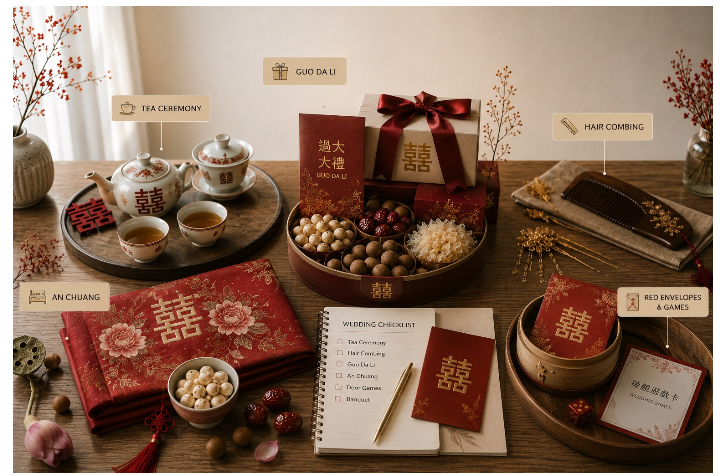
From Guo Da Li and An Chuang to the Hair Combing Ceremony and Tea Ceremony, many modern couples wonder which traditions are essential, which can be simplified, and which are purely optional.
The truth is, there is rarely a single "correct" answer.
Chinese wedding traditions have evolved over generations and differ across dialect groups, family values and personal circumstances. What works for one family may not be suitable for another.
Rather than asking: "What can we skip?"
We encourage couples to ask a slightly different question: "Which traditions should we keep, simplify or adapt to create a meaningful wedding for our families?" This guide isn't about telling you what you should or shouldn't do.
It's about helping you understand the purpose behind each tradition, so you can make informed decisions that suit your family, your circumstances and the wedding you want to create.
At a Glance
Tradition | What We're Seeing Today |
🍵 Tea Ceremony | Still widely observed. Many couples adapt the format rather than omit it. |
🎁 Guo Da Li | Commonly simplified. Symbolism often takes priority over elaborate gift exchanges. |
🪮 Hair Combing | Frequently simplified while retaining the blessings. |
🛏️ An Chuang | Often adapted, especially for couples already living together or staying in a hotel after the wedding. |
🎉 Gatecrash | Entirely personal. Many couples now choose lighter games—or skip it altogether. |
Every family is different. Think of this as a general guide rather than a rulebook.
Tea Ceremony (敬茶)
Why It Still Matters
Among all the traditional Chinese wedding customs, the tea ceremony remains one of the traditions that many families continue to hold closest to their hearts.
For many Chinese families, it is often regarded as the emotional heart of the wedding day—sometimes even more significant than the solemnisation itself.
While the solemnisation is the legal union between two individuals, the tea ceremony represents something different. It is the moment where the bride and groom formally pay their respects to their elders, receive their blessings, and are welcomed into each other's families.
In many ways, it marks the joining of two families and the welcoming of a new son or daughter into the family.
Ask Yourselves
Is the tea ceremony something your parents or grandparents have been looking forward to?
If time is limited, could the ceremony be adapted rather than omitted?
Could both tea ceremonies be held at one location, or could the sequence be adjusted to better suit your wedding day?

Today's Perspective
Although many couples simplify other traditions, the tea ceremony is often the one they continue to keep.
Many couples today admit they're unfamiliar with
how to address some of their relatives or even how everyone is related. As families become smaller and relatives meet less often, these traditional relationships are becoming less familiar to the younger generation.
We're also seeing tea ceremonies become more time-sensitive. With packed wedding schedules, the ceremony is often completed much more quickly than before.
If your wedding day timeline simply doesn't allow for a meaningful tea ceremony, one option that some couples have explored is holding the tea ceremony on the same day as Guo Da Li. While still relatively uncommon, it allows both families to enjoy the ceremony in a more relaxed setting and eases the schedule on the actual wedding day.
Yet regardless of when it is held, the tea ceremony remains far more than a ceremonial serving of tea. It is the moment where two families formally welcome a new son or daughter into the family, while expressing gratitude, respect, and blessings for the couple's new chapter together.
Continue Reading: Chinese Tea Ceremony (敬茶): What You Need to Know to Do It Right
Guo Da Li (过大礼)
More Symbolic Than Ever

Traditionally, Guo Da Li marks the formal betrothal between two families and symbolises the groom's sincerity in asking for the bride's hand in marriage.
Today, many couples continue to observe this tradition—but in a much simpler and more personalised way.
Ask Yourselves
Is Guo Da Li important to either family?
Would a simplified exchange still honour the intention behind the tradition?
Have both families discussed what they expect from the ceremony?
Today's Perspective
Many families are reducing the number of traditional gift items and focusing on a symbolic exchange instead.
We're also seeing couples move beyond traditional gold jewellery. Some now choose luxury watches, diamond jewellery or pieces they know they'll continue wearing long after the wedding, rather than jewellery that's only worn on special occasions.
The dowry (聘金) has also become increasingly symbolic. Many families agree on a token amount, or return part or all of it to the couple, emphasising that it is a gesture of appreciation and goodwill rather than a financial transaction.
Another interesting observation is that some families choose to present the betrothal gifts again during the tea ceremony, even though they were already exchanged during Guo Da Li.
This isn't about repeating the tradition. For some families, it allows relatives and guests to witness the symbolic exchange, celebrating the goodwill between both families. In Chinese culture, the idea of "face" (面子) can sometimes influence how traditions are presented publicly—not necessarily because of the monetary value involved, but because the gesture itself reflects sincerity, generosity and respect.
Continue Reading: Guo Da Li (过大礼): Everything You Need to Know
Hair Combing Ceremony (上头)
A Quiet Blessing Before the Wedding

The Hair Combing Ceremony symbolises blessings for a harmonious marriage, longevity and a happy family life. Traditionally, it is performed by a parent or elder whose marriage is
regarded as harmonious and blessed.
Compared with other Chinese wedding traditions, this is one custom many couples choose to simplify.
Ask Yourselves
Does this tradition hold special meaning for your family?
Is there someone you'd like to receive this blessing from?
Would a simple symbolic ceremony be just as meaningful?
Today's Perspective
For many couples, the significance of the Hair Combing Ceremony lies less in following every traditional step and more in receiving heartfelt blessings from someone important before beginning married life.
Some couples choose to observe a simplified version, while others respectfully decide not to include it in their wedding plans.
Continue Reading: Hair Combing Ceremony (上头): Meaning, Traditions and Modern Practice
An Chuang (安床)
Does It Still Make Sense Today?
Traditionally, An Chuang refers to preparing and blessing the couple's matrimonial bed before the wedding. It symbolises wishes for a harmonious marriage, prosperity and a happy family life.
As modern living arrangements have changed, this is also one of the traditions that has naturally evolved.

Ask Yourselves
Have you already moved into your new home?
Will you be spending your wedding night in a hotel?
Is An Chuang important to your parents?
If a traditional setup isn't practical, would a symbolic blessing be meaningful instead?
Today's Perspective
Many couples today have already moved into their new home long before the wedding.
Others spend their wedding night at a hotel before returning home after the celebrations. These changing lifestyles naturally raise questions about how An Chuang fits into modern weddings.
Rather than asking whether it should be skipped entirely, many families choose to adapt the tradition in a way that better suits their circumstances while preserving its symbolic meaning.
Continue Reading: An Chuang (安床): Everything You Need to Know
Gatecrash
Tradition or Personal Preference?

Unlike many Chinese wedding customs, today's gatecrashing has evolved into a fun and light-hearted wedding activity rather than a deeply rooted traditional ceremony.
For some couples, it's one of the highlights of the wedding morning. For others, it's simply not something they enjoy.
Ask Yourselves
Do you want an energetic start to your wedding day?
Will the games add to the experience, or create unnecessary stress?
Is there enough time in your schedule for a gatecrash without rushing the rest of the day?
Today's Perspective
One trend we've noticed is that gatecrash games have become much gentler than they were in the past.
Rather than seeing how much the groom can endure, many couples now prefer games that create laughter and memories for everyone involved.
Others choose to skip the gatecrash altogether, preferring a calmer wedding morning or simply wanting to avoid unnecessary delays before the tea ceremony.
Ultimately, whether or not you include a gatecrash says very little about how traditional your wedding is. It is simply a personal choice.
The Red Wedding Perspective
The most meaningful Chinese weddings aren't necessarily the ones that follow every tradition perfectly.
They're the ones where couples understand the meaning behind each custom, have open conversations with their families, and thoughtfully adapt traditions to suit their circumstances.
Traditions were created to celebrate a marriage, not to create unnecessary stress.
If a custom no longer fits your timeline or wedding plans, ask whether it can be adapted rather than assuming it has to be skipped entirely.
More often than not, it's possible to preserve the meaning without following every step exactly as it was done generations ago.
At the end of the day, the goal isn't to have the most traditional wedding.
It's to begin your marriage with the blessings, respect and support of the people who matter most.
❤️ Not sure where to start? We're always happy to help. Get in touch with us if you'd like to chat through your wedding plans or understand your options.
Frequently Asked Questions
Is the tea ceremony compulsory?
No. However, it remains one of the most meaningful traditions for many Chinese families and is often retained even when other customs are simplified.
Which Chinese wedding traditions are most commonly simplified?
Many couples today choose to simplify Guo Da Li, the Hair Combing Ceremony and An Chuang while preserving the symbolism behind each tradition.
Can we customise our Chinese wedding traditions?
Absolutely. Every family is different. The key is to understand the purpose behind each custom before deciding how best to adapt it.
What if both families have different expectations?
Start the conversation early. Understanding what each tradition means to both families often makes it easier to find a compromise that everyone is comfortable with.
Is gatecrash a traditional Chinese wedding custom?
While it has roots in older customs surrounding the groom fetching the bride, today's gatecrash has largely evolved into a modern wedding activity and is entirely optional.


Comments